What is the difference between notarisation, attestation, authentication, legalisation, and apostille?
Process | What it does | Who handles it | Is it always required? |
Notarisation | Witnesses or certifies certain signatures, documents or copies | Notary public or authorised professional | No |
Authentication | Verifies the signature or seal of a Canadian official or recognised authority | Canadian competent authority | Depends on destination |
Apostille | Authenticates a Canadian public document for use in the Hague Convention countries | Canadian competent authority | Yes, if the destination is a Convention member |
Consular legalisation | Provides additional recognition for a document intended for a non-Hague country | Destination country's embassy or consulate | Depends on destination |
Attestation | Destination-specific term for document certification or verification | Depends on the country | Depends on destination |
Note: When a foreign employer or ministry asks for "attested documents," they are rarely asking for something a Canadian office can issue under that name. They mean a document that has been through the Canadian verification chain and, if their country is outside the Apostille Convention, through their own consular legalisation.
Which route does your document need?
These three questions will help you determine what step to take.
Is the destination country a member of the Hague Apostille Convention?
Check the HCCH status table. It lists every contracting party and the date the Convention entered into force there. Accession and entry into force are separate dates, so confirm both.
Yes: Your document needs an apostille from the Canadian competent authority. Nothing further.
No: Your document needs Canadian authentication, then consular legalisation at the destination country's embassy or consulate in Canada. Some countries, including the UAE, then require a further attestation step at their Ministry of Foreign Affairs after the document arrives.
Is your document public or private?
Public documents issued by a government body, such as birth, marriage, and death certificates, court documents, and provincial credentials, go straight to the competent authority.
Private documents you sign or have signed on your behalf, such as affidavits, statutory declarations, powers of attorney, and corporate resolutions, must be notarised first. A notary confirms the signature; the competent authority then certifies that notarisation.
Where was the document issued or notarised?
This determines which office handles it.
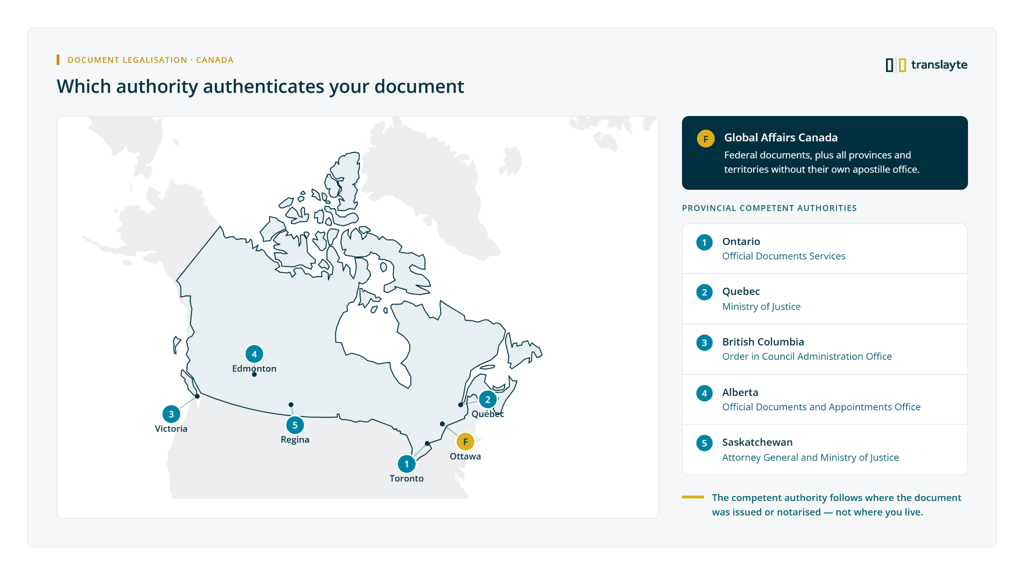
Global Affairs Canada handles documents issued by the federal government. This includes RCMP criminal record checks issued in Ottawa, federal incorporation certificates, and federal department records. It also handles documents issued or notarised in provinces and territories without their own apostille office. Such provinces include Manitoba, New Brunswick, Newfoundland and Labrador, Nova Scotia, Prince Edward Island, Northwest Territories, Nunavut, and Yukon.
Ontario, Alberta and Saskatchewan each handle documents notarised in their province, regardless of where the underlying document was issued.
British Columbia and Quebec offices will certify a notarised document only if the original document was also issued in that province. If your document was issued elsewhere and notarised in BC or Quebec, it goes to Global Affairs Canada instead.
Quebec has an extra step. Documents signed before a Quebec notary or lawyer must first have that signature verified by the Chambre des notaires or the Barreau du Québec before the Ministry of Justice will issue an apostille.
Need an apostille? Translayte provides apostille services for Canadian documents, helping you skip the stress of visiting different offices. Upload your documents, and we will let you know the next steps.
When do you need certification for a Canadian document?
You may need certification for a Canadian-issued document when submitting it for work, study, marriage, legal, or business overseas.
Working or studying abroad
The foreign university, ministry of education, licensing body or employer may ask for attested documents. Whether you need an apostille or consular legalisation also depends on the receiving authority.
Typical documents needed for work and study include degrees, diplomas, academic transcripts, and professional certificates.
Immigration and residency
If you are applying for a visa, permanent residency, or another immigration procedure, you may need authentication for documents such as birth certificates, marriage certificates, death certificates, change-of-name certificates, and police certificates. Some visa authorities also accept certified copies or certified translations without any further certification.
Getting married abroad
Civil registries ask for documents to prove you are legally free to marry, such as a Single Status Certificate and a Certificate of No Impediment. Canada provides a statement in lieu of a certificate of non-impediment, and, depending on the destination, it needs to be attested or notarised before submission.
Business and commercial purposes
Companies setting up business abroad must submit contracts, commercial agreements, articles of incorporation, and corporate certificates. These documents may need notarisation, authentication, and apostille in Canada, or attestation in the receiving country.
Legal proceedings
If you are involved in a legal proceeding abroad and need to submit documents from Canada to support your defence, you may need to get them authenticated. Some documents you may need include powers of attorney, affidavits, statutory declarations, and court rulings.
Note: When the document is going to a country with a different official language, you may need a certified/sworn translation. Always confirm with the receiving authority what’s required before starting your application.
Mistakes to avoid when certifying documents in Canada for use abroad
In our experience, apostilled documents may be rejected for these reasons:
Following the wrong sequence: Apostille the Canadian original before translating. If you do it the other way round, you often end up paying to apostille the translation as a separate document.
Failing to translate the apostille: The apostille usually arrives as a separate certificate attached to your document, and several countries want it translated along with everything else.
Sending the document to the wrong province: A document issued in Alberta but notarised in BC won't be handled by BC's provincial office; it goes to Global Affairs Canada instead. Get the notary in the province that issued the document.
How the Canadian authentication and apostille process works
Not every Canadian document goes through every step below. What you need depends on the destination country and their requirements.
Step 1: Check the destination country's requirements
Before you prepare, notarise or send anything, confirm what the destination country requires. You can find the information on the receiving authority's website and the HCCH status table. The information will determine whether you need an apostille or a longer certification chain.
Step 2: Prepare the document
Some documents are accepted as originals; others need to be notarised or certified before they can be authenticated. You will find this information on the receiving authority's website. Check for sections with statements like:
Submit original documents or certified true copies for attestation.
A professional translator must translate documents.
Have the competent authority notarise the documents.
Step 3: Notarise the document if required
Notarisation may be necessary for certain private documents, or for documents whose signatures must be witnessed before authentication. Common examples include affidavits, statutory declarations, powers of attorney and other privately signed documents.
Notarisation is not the same as authentication or apostille, but it is often a part of the process for certain documents. A notary confirms a signature or certifies a copy; they do not verify the document is valid for international use.
Step 4: Send it to the right competent authority
The competent authority depends on where the document was issued or notarised. Canada has designated provincial competent authorities in Alberta, British Columbia, Ontario, Quebec, and Saskatchewan. Documents from the other provinces and territories may fall under Global Affairs Canada's federal process, depending on the document.
Step 5: Obtain an apostille, or continue to legalisation
If the destination is a Hague Apostille Convention country, the competent Canadian authority, such as Global Affairs Canada, issues an apostille. This step removes the need for any further legalisation.
If the destination is not a Convention country, the documents must follow the usual route of Canadian authentication, followed by legalisation at the destination country's embassy or consulate. Some countries, like the UAE, also require attestation at the Ministry of Foreign Affairs (MOFA) before submitting to the requesting authority. Confirm the embassy's current requirements before sending. Some embassies require an appointment, some require a covering letter from the applicant, and several will only accept documents submitted by an authorised agent.
Canadian competent authorities: apostille fees and processing times
Authority | What it covers | Fee per document | Processing time | How to submit |
Global Affairs Canada | Federal documents; Manitoba, New Brunswick, Newfoundland and Labrador, Nova Scotia, Prince Edward Island, Northwest Territories, Nunavut, and Yukon | No fee | 20 business days | Mail or courier only |
Ontario: Official Documents Services (ODS) | Documents notarised or issued in Ontario | $16 notarised / $32 Ontario-issued | 15 business days by mail; same-day in person | Mail or in person |
British Columbia: Order in Council Administration Office (Ministry of Attorney General) | BC-issued documents; BC-notarised only if BC-issued | $20 | 4–6 weeks | Mail |
Alberta: Official Documents and Appointments Office within the Ministry of Justice | Documents notarised or issued in Alberta | $25 | 7–10 business days | Mail |
Saskatchewan: Attorney General and Ministry of Justice | Documents notarised or issued in Saskatchewan | $50 | 3–5 business days | Mail |
Quebec: Ministry of Justice | Quebec-issued documents; Quebec-notarised only if Quebec-issued | $66.50, plus Barreau/Chambre verification ~$50 + tax if you need to apostille a notarised document. The extra fee covers verifying the lawyer’s signature. This is done before you mail your documents to the apostille office. | From 10 business days, plus 5 for the verification step | Mail |
Fees and times as at September 2026. Shipping is extra and is not included above; allow for it in both directions. Confirm current figures with the authority before sending, as these change without notice.
Do you need a certified translation for attestation?
Whether you need a certified translation in Canada before attestation depends on the receiving authority. We apostille before we translate, and we recommend you do the same. It isn't a preference; an apostille certifies the signature and seal on whatever it's attached to. So an apostille obtained on a translation certifies your translator, not the Canadian authority that issued your birth certificate. Receiving bodies need the apostille to verify the issuing authority's signature, not the translator's.
In practice, most people arrive having already handled this step. Of the Canadian documents we translated last year, we were asked to arrange the apostille on five. Everyone else came to us with the original already apostilled, or not needing one at all.
The translation may also need to meet specific certification requirements. It may need to be produced by a translator holding a particular accreditation, or accompanied by a signed certification statement. In the UAE, a Ministry of Justice (MOJ) licensed translator must do the translation, while Spain requires a translator appointed by the Ministry of Foreign Affairs (MAEC).
Does the translation itself need authentication?
Not always. The receiving authority determines whether the translation must be certified, notarised or separately authenticated. In some cases the translation is authenticated alongside the original; in others only the source document is.
If you also need a certified translation in Canada, Translayte provides apostille and translation services so you don’t have to order them separately. Request a free quote to get pricing for your Canadian document.
Note: Translayte provides certified translation, notarisation and apostille services, so the sequencing advice above is what we see in customer orders rather than a neutral survey. Confirm the order with your receiving authority.
Get your Canadian documents certified for use abroad
Not sure whether your Canadian document needs an apostille, authentication, legalisation or a certified translation?
Translayte can help you:
Handle the submissions, apostille, and the Quebec verification step.
Arrange certified translation of Canadian documents, including work by certified translators for English (Canada) and French (Canada)
Arrange notarisation in Canada where required.
Arrange authentication and apostille through the competent authority, quoted per document and destination.
Request a quote or upload your document, and we will confirm what is required for your destination.

.jpg)